 More than 25 years after its West End debut, MAMMA MIA! arrives in Nottingham showing remarkably few signs of age. The songs are as familiar as anything in musical theatre, the story has become part of popular culture and many in the audience know exactly what is coming. Somehow, none of that diminishes the sheer pleasure of watching it unfold.
The premise remains wonderfully ridiculous. On the eve of her wedding on a Greek island, Sophie Sheridan discovers that any one of three men could be her father and, without telling her mother Donna, invites all three to the ceremony. Naturally, they all turn up.
What follows is built around the music of ABBA, but MAMMA MIA! has always been rather better than the term ‘jukebox musical’ suggests. Catherine Johnson’s book finds genuine purpose in the songs, using them to explore relationships between parents and children, old friends and former lovers.
At the centre of it all is Jenn Griffin’s Donna Sheridan. Griffin gives Donna the toughness needed to make sense of a woman who has raised her daughter alone and built a life for herself, while allowing glimpses of the vulnerability underneath. Her performance of The Winner Takes It All is outstanding. There is no need for theatrical excess here. Griffin simply allows the song to do its work, and a number written decades before the musical suddenly feels entirely at home in Donna’s story.
Hazel Baldwin is an immensely likeable Sophie. She captures the character’s youthful certainty beautifully: Sophie begins convinced that finding her father will somehow fill in a missing piece of herself, only to discover that adulthood, relationships and family are considerably messier than she imagined. The scenes between Baldwin and Griffin are among the most affecting of the evening, particularly Slipping Through My Fingers.
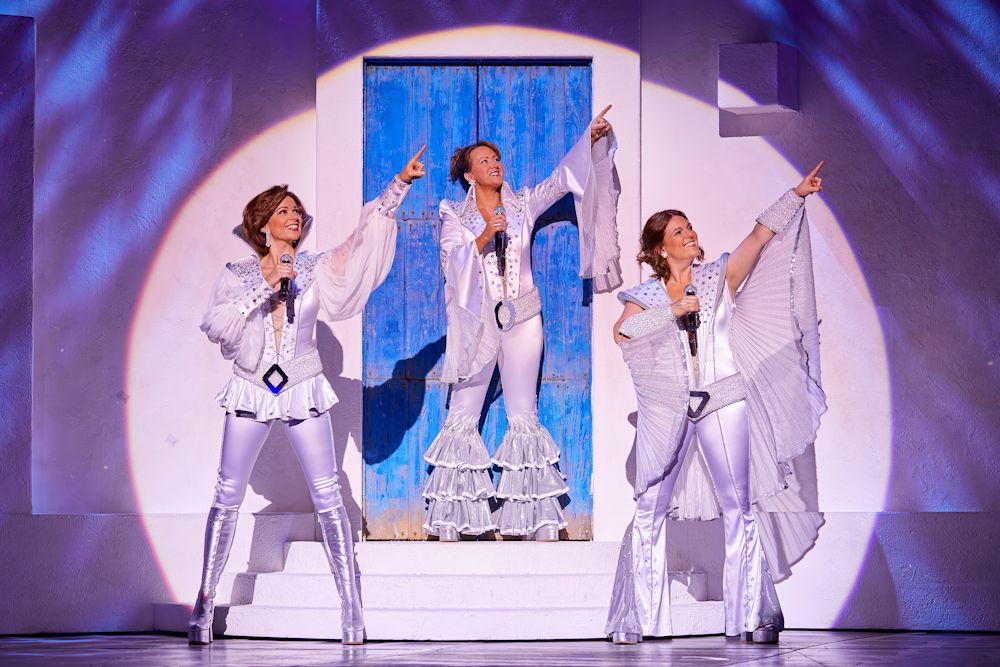
Then there are the Dynamos.
Sarah Earnshaw’s Tanya and Lauren Woolf’s Rosie are terrific company. Earnshaw has wonderfully dry comic timing and carries Tanya’s confidence with ease, while Woolf throws herself into Rosie’s humour without turning her into a caricature. Together with Griffin they create a friendship that feels as though it existed long before the curtain went up.
That matters. Dancing Queen works not simply because everybody knows it, but because it becomes three old friends briefly rediscovering younger versions of themselves. It is funny, affectionate and completely joyous.
The three potential fathers are nicely distinguished too. Richard Taylor Woods gives Sam Carmichael a sincerity that becomes increasingly important as Donna’s history emerges, while Simon Victor’s Bill Austin and Arvid Larsen’s Harry Bright bring plenty of warmth and humour. The production wisely resists making any of them merely the punchline to Sophie’s increasingly chaotic plan.
Samuel Downey gives Sky an easy charm, and the ensemble rarely allows the production’s energy to dip. Anthony Van Laast’s choreography comes into its own when the stage fills, with Voulez-Vous in particular building into a thrilling end to the first act.
Mark Thompson’s set remains deceptively simple. White walls and blue accents immediately establish the Greek island setting, while the uncluttered design gives the company space to move. There is little interest in creating a realistic island paradise and the production is better for it. A few carefully chosen pieces are enough to take us there.
And, of course, those songs are almost unfairly good.
Money, Money, Money, Chiquitita, Dancing Queen, Super Trouper, Gimme! Gimme! Gimme!, SOS, Knowing Me, Knowing You, Voulez-Vous and Take a Chance on Me would constitute an enviable set list before even considering the songs left over.
What becomes apparent when hearing them in this setting is how much sadness sits within ABBA’s music. The melodies can be euphoric while the words deal with separation, regret, jealousy and relationships falling apart. MAMMA MIA! understands that. The production can be gloriously silly one moment and unexpectedly tender the next without either feeling out of place.
It is also extremely funny. The comedy is broad when it needs to be, particularly as Donna attempts to deal with three pieces of her past arriving simultaneously, but much of the best humour comes from the performances rather than from chasing laughs.
By the closing numbers the pretence that anybody is expected to remain quietly in their seat has largely disappeared. The costumes get brighter, the volume rises and the Royal Concert Hall becomes a celebration of ABBA as much as a performance of MAMMA MIA! It would take considerable determination not to be swept along with it.
For all the sunshine, flares and irresistible pop songs, there is real affection at the centre of the show. It understands that families can be complicated, that people rarely have everything figured out when they think they do and that friendships formed decades ago can still be the ones that hold us together.
MAMMA MIA! may have one of the most recognisable soundtracks in theatre, but its continued success cannot be explained by nostalgia alone. This Nottingham production is warm, funny, beautifully performed and almost absurdly enjoyable.
By the time the final notes have disappeared, the only sensible response is to admit defeat and join the party.
MAMMA MIA! runs at the Royal Concert Hall, Nottingham until 10 October 2026.