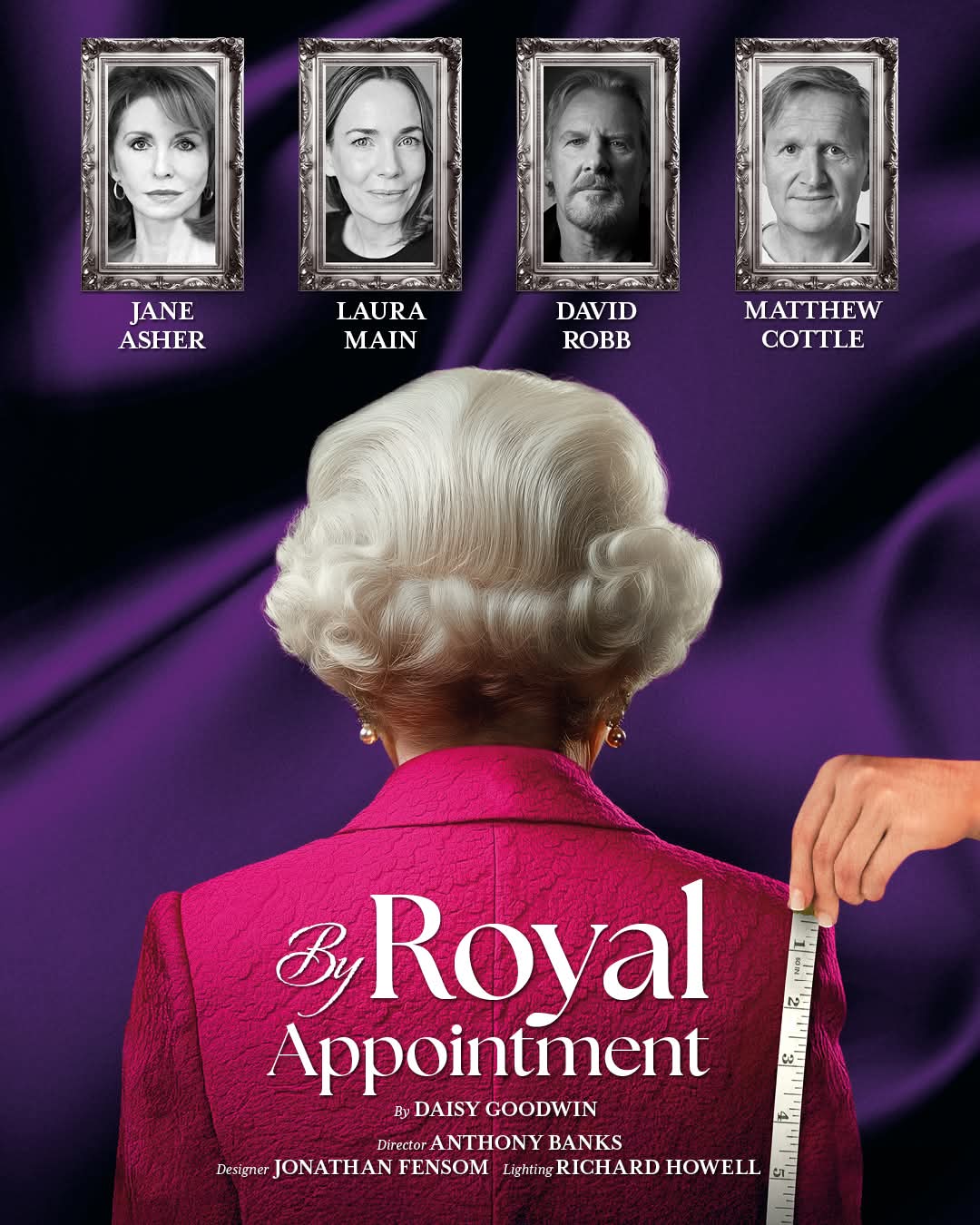
On the surface, Daisy Goodwin’s By Royal Appointment is a play about the clothes of Queen Elizabeth II. Look a little closer, however, and it becomes something considerably more interesting: an examination of the exhausting amount of thought women are expected to devote to how they look, what their appearance says about them and how quickly they will be judged when they get it wrong.
The Queen may have been an exceptional woman in an exceptional position, but the pressure the play depicts is remarkably ordinary. Her clothes will be examined. Her weight will be commented upon. Her choices will be interpreted. She must look appropriate without appearing dull, distinctive without appearing frivolous, regal without seeming extravagant. She must be noticed, but for precisely the right reasons.
Jane Asher’s beautifully controlled performance makes the cumulative weight of this expectation apparent. Her Queen is surrounded by people discussing her body, her clothes and her appearance as though these things are matters of public property.
In a sense, of course, they were.
That is one of the most fascinating tensions in By Royal Appointment. The Queen is arguably the most privileged woman in Britain, yet even she cannot escape the scrutiny routinely directed at women’s appearance. Indeed, her position magnifies it. Every outfit might be photographed, every photograph reproduced around the world and every choice interpreted by journalists and commentators.
What the play reveals particularly well is the extraordinary mental labour involved.
Choosing an outfit is rarely simply choosing an outfit. Where will the Queen be standing? What will be behind her? Will she need to be visible across a crowd? Is the colour appropriate to the occasion? What does it look like on television? Can people see her face beneath the hat? Is the hem practical? Has she worn something similar recently? Might a colour, fabric, brooch or motif accidentally carry a political or diplomatic meaning?
The sheer number of calculations is astonishing.
And there is something exhausting about watching them accumulate. Imagine having to think at that level every time you leave the house.
This is where Goodwin’s play reaches beyond its royal setting. Most women will never have a team designing their clothes or newspapers analysing their choice of hat, but the underlying judgement is familiar. Women are routinely expected to understand an unwritten language of appearance: too formal, too casual, too revealing, too conservative, too young, too old, too much effort, not enough effort.
Men are certainly judged by appearance too, but By Royal Appointment makes a persuasive case that women’s clothes are expected to perform an additional communicative function. Appearance becomes evidence from which personality, seriousness, competence and character are inferred.
The cleverness of the Queen and those around her was that, rather than pretending this judgement did not exist, they learnt to manipulate it.
If people were going to scrutinise what the Queen wore, then what she wore could become a means of communication.
Colour could make her visible to people who had waited hours in a crowd. Jewellery could acknowledge a host nation. A carefully selected motif could carry meaning without requiring a speech. Even the famous hats had a practical purpose: the public had come to see the Queen, and therefore they needed actually to be able to see her.
Clothing consequently becomes a fascinating substitute for the political voice the monarch cannot freely exercise.
That gives Goodwin’s premise real depth. Elizabeth II occupied a strange position in which almost everything she did could be interpreted politically while she herself was required to remain publicly above politics. Words were dangerous. Clothes offered another vocabulary: ambiguous enough to preserve constitutional neutrality, yet capable of suggesting recognition, respect, humour or solidarity.
Whether every supposed message identified by observers was actually intended is almost beside the point. Once people believed the Queen communicated through clothing, the wardrobe itself became part of the institution.
Laura Main’s Dresser is therefore far more than someone who helps the Queen get ready.
She is participating in the construction of a public identity.
Main brings energy, humour and increasing complexity to the relationship. There is genuine intimacy between dresser and monarch, but By Royal Appointment is intelligent enough not to confuse intimacy with equality. One woman may see the Queen in circumstances unavailable to almost anyone else, but she remains an employee. However affectionate the relationship becomes, hierarchy is always present.
David Robb’s Designer and Matthew Cottle’s Milliner extend the idea further. The apparently effortless image presented to the public turns out to require an enormous amount of invisible work.
That word — invisible — matters.
The Queen appears. Everyone else has already worried about the details.
There is an interesting parallel here with the wider expectations the play places under examination. Looking “right” is supposed to appear effortless, while the work required to achieve it remains largely unseen. The finished image conceals the labour that produced it.
The production is at its strongest when it allows us to notice that contradiction for ourselves rather than simply presenting an affectionate collection of royal anecdotes.
Jane Asher is particularly effective because she avoids caricature. The familiar rhythms and mannerisms are there, but this is not an impersonation assembled from recognisable gestures. Instead she finds the discipline beneath the image: a woman who has spent decades knowing that whenever she enters a room people are looking at her.
That knowledge must itself have been exhausting.
And yet By Royal Appointment also shows Elizabeth gradually turning scrutiny into one of the tools of the job. The brightly coloured coats, carefully selected jewellery and unmistakable silhouette became almost a visual language. If the world insisted upon looking, she and her team became extraordinarily skilled at deciding what it would see.
That is a far more interesting proposition than simply celebrating the Queen as a style icon.
It presents clothing simultaneously as burden and power.
Women are judged by their appearance; the Queen could not escape that. What she could do was understand the rules sufficiently well to exploit them.
There is therefore something quietly subversive beneath the hats, handbags and beautifully tailored coats of By Royal Appointment. Its subject may be one extraordinarily famous woman’s wardrobe, but its questions belong to women far beyond Buckingham Palace.
How much time do women spend thinking about how they will be seen? How many judgements are made before they have spoken? And how much invisible work goes into producing the apparently effortless version of themselves that the world expects?
For Queen Elizabeth II, those pressures existed on an almost unimaginable scale.
By Royal Appointment succeeds because it shows us the machinery behind that familiar image. The Queen the public saw was not accidental. Every colour, line and detail had been considered by a group of people acutely aware that millions would be looking.
And perhaps that is the play’s most revealing observation. Elizabeth II could not prevent the world from judging a woman by what she wore.
So she learnt to make what she wore say something back.