
There are productions that ask you to admire the choreography, and there are productions where, within minutes, you almost forget that what you are watching is choreography at all.
Matthew Bourne’s The Car Man emphatically belongs to the latter.
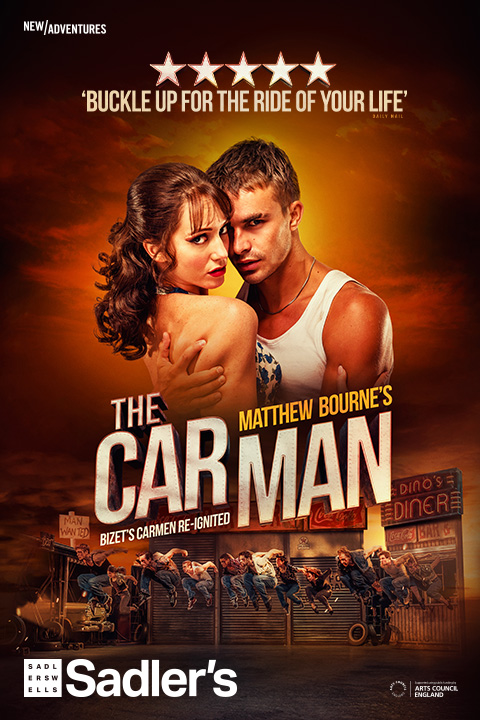
Returning to Nottingham’s Theatre Royal as part of its first major UK tour in more than a decade, Bourne’s reimagining of Carmen is a scorching, muscular and remarkably cinematic piece of theatre. It is ballet, certainly, but anyone arriving with a fixed idea of what ballet looks or feels like may find those expectations comprehensively dismantled before the first act is over.
Bizet’s 19th-century Spanish cigarette factory has disappeared. In its place is Harmony, a dusty, claustrophobic American town dominated by Dino’s garage and diner. Into this closed little world walks Luca, a drifter whose arrival acts less like a catalyst than a lit match tossed into petrol.
And from there, things get very messy indeed.
What is immediately striking about The Car Man is just how clearly Bourne tells his story without a single spoken word. Desire, jealousy, insecurity, violence and fear are communicated through bodies, glances and tiny physical gestures. Characters do not simply dance with one another; they circle, challenge, seduce, reject and threaten each other.
The result is theatre that feels extraordinarily alive.
Bourne’s choreography is also gloriously uninterested in making everything conventionally beautiful. There is beauty here – enormous amounts of it – but there is sweat, aggression and awkwardness too. Bodies collide. Men square up to one another. Couples grapple as much as embrace. At times the movement has the elegance and precision expected of classical dance; seconds later it feels raw enough to have broken out spontaneously in the corner of a bar.
That contrast is crucial because The Car Man is fundamentally about desire and what happens when desire becomes destructive.
Luca is the gravitational force at the centre of Harmony. His sexuality refuses to fit neatly into the expectations of the world around him, and Bourne makes that central rather than incidental. Attraction moves between men and women with an ease that gives the production a surprisingly contemporary edge despite its 1950s setting.
But perhaps the most affecting strand belongs to Angelo, the awkward outsider who becomes trapped in events far beyond his control. Amid all the swagger and sexuality, his vulnerability gives the story its emotional weight. The physical vocabulary changes around him: where others dominate the space, Angelo often seems swallowed by it. It is a wonderfully effective piece of characterisation through movement.
The company as a whole is exceptional. This is not a production in which the ensemble simply waits around for the principals to finish. Harmony feels populated from the moment we arrive. Everywhere you look, somebody is flirting, watching, drinking, working, arguing or reacting. Even at the edges of the stage there are stories being told.
That detail makes Lez Brotherston’s garage-diner setting feel less like scenery and more like an actual place. It is grimy, sun-baked and wonderfully evocative, while Chris Davey’s lighting seems almost capable of raising the temperature inside the Theatre Royal. The oppressive heat of Harmony becomes part of the drama: this feels like a town in which everyone has been simmering for far too long.
And then there is the music.
Rodion Shchedrin’s Carmen Suite, after Bizet, augmented by Terry Davies, is magnificent. Familiar melodies arrive transformed – sometimes seductive, sometimes playful, sometimes almost brutally percussive. Bourne understands exactly how much dramatic power already exists within the score and allows the choreography to ride it rather than compete with it.
The marriage of movement and music can be thrilling. A flick of a head, a punch, a kiss or a sudden shift across the stage lands precisely against the score, giving whole sequences the rhythm of film editing. Indeed, The Car Man often feels closer to watching a great piece of film noir than conventional ballet.
That cinematic quality becomes even stronger as the story darkens.
The carefree sexuality and humour of the opening gradually curdle into jealousy, murder, accusation and revenge. Bourne is remarkably good at allowing the audience to enjoy the sheer sensuality of this world while quietly tightening the narrative around its characters. By the latter stages, actions that initially appeared impulsive have consequences that cannot be escaped.
It is also striking how little The Car Man has dated since its creation in 2000. If anything, its refusal to divide desire neatly along heterosexual lines and its fascination with masculinity, vulnerability and power feel even richer now. There is plenty of sexiness here – and the production knows perfectly well that there is – but underneath it lies something considerably more interesting about people performing the identities expected of them.
That is perhaps Bourne’s greatest trick.
The Car Man can be enjoyed simply as an exhilarating night of dance. It is sexy, funny, violent, visually spectacular and propelled by one of the most recognisable scores in classical music.
But look beneath the surface and there is much more happening.
This is a story about outsiders and insiders, about possession masquerading as love, about masculinity and vulnerability, and about a community whose carefully maintained order is exposed as remarkably fragile the moment somebody refuses to obey its rules.
Twenty-six years after it was first created, The Car Man still feels dangerous.
And on the Theatre Royal stage, it absolutely roars.
Matthew Bourne’s The Car Man
Theatre Royal, Nottingham
Until Saturday 26 September 2026