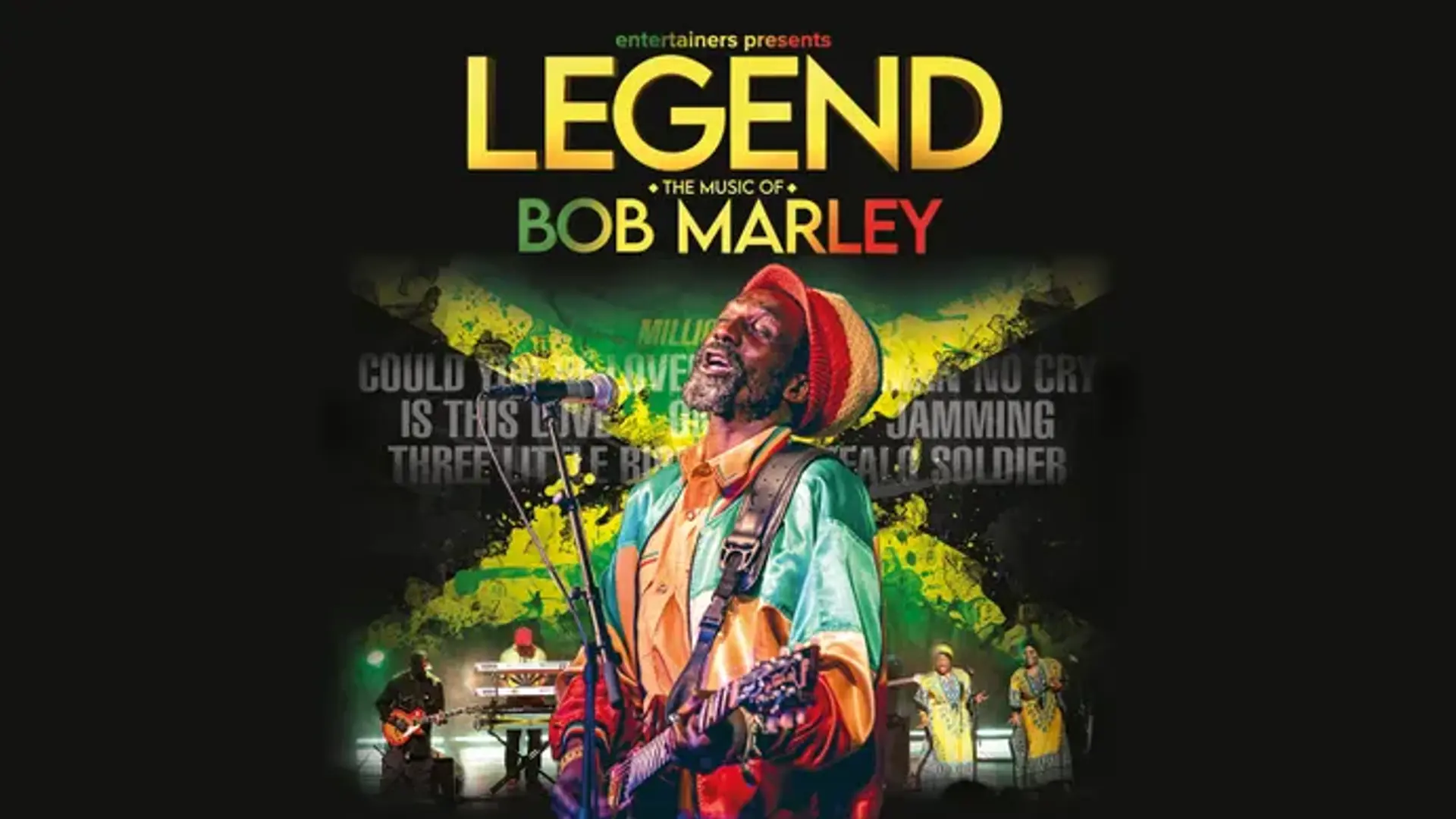
Few artists have left a musical legacy quite like Bob Marley. More than four decades after his death, his songs remain as uplifting, relevant and politically charged as ever. Legend: The Music of Bob Marley is a joyous celebration of that extraordinary catalogue, reminding audiences why the Jamaican icon remains one of popular music’s most influential figures.
It is easy to forget just how revolutionary Marley was. When he and The Wailers brought reggae to international audiences in the 1970s, they were introducing the world to music deeply rooted in Jamaica’s experiences of colonialism, poverty and political struggle. Marley transformed reggae into a global phenomenon without sacrificing the conviction that gave it meaning.
Legend places the music firmly at the centre of proceedings. Rather than attempting an elaborate biography, the production celebrates the songs themselves, with a full live band bringing warmth, energy and infectious rhythm to a catalogue that scarcely needs an introduction.
From the irresistible optimism of Three Little Birds and Is This Love to the rhythmic brilliance of Jamming and Could You Be Loved, the strength of Marley’s songwriting is undeniable. Reggae’s apparently effortless grooves conceal considerable musical sophistication, with melodic basslines, offbeat guitars and carefully measured rhythms combining to create something instantly recognisable.
Yet Marley’s greatest achievement was arguably his ability to make music that was both enormously entertaining and profoundly meaningful.
Get Up, Stand Up remains a powerful declaration of resistance, while Exodus and Buffalo Soldier explore themes of liberation, displacement and injustice. These were not fashionable political statements but reflections of an artist whose experiences were shaped by the turbulent Jamaica of the 1970s.
His influence extended far beyond reggae. In Britain, Marley’s music helped inspire the emerging punk movement and later the Two Tone revolution, providing a soundtrack to a generation confronting racism and social inequality. That music once considered subversive is now celebrated in prestigious theatres is perhaps the clearest demonstration of its extraordinary cultural impact.
There is also something particularly fitting about this Nottingham performance taking place during Black History Month. Marley’s contribution to Black music and culture cannot be overstated, and his message of unity remains as necessary today as it was half a century ago.
Above all, Legend is a celebration of music’s remarkable ability to bring people together. These are songs that invite participation, encourage optimism and transcend generations. Their familiarity has done nothing to diminish their emotional power.
Bob Marley died in 1981, aged just 36, but his music has never stopped speaking to new audiences. Legend: The Music of Bob Marley offers an uplifting reminder that great music can entertain, inspire and challenge in equal measure.
Marley’s genius was to make people dance while encouraging them to think. More than forty years later, that remains a legacy well worth celebrating.