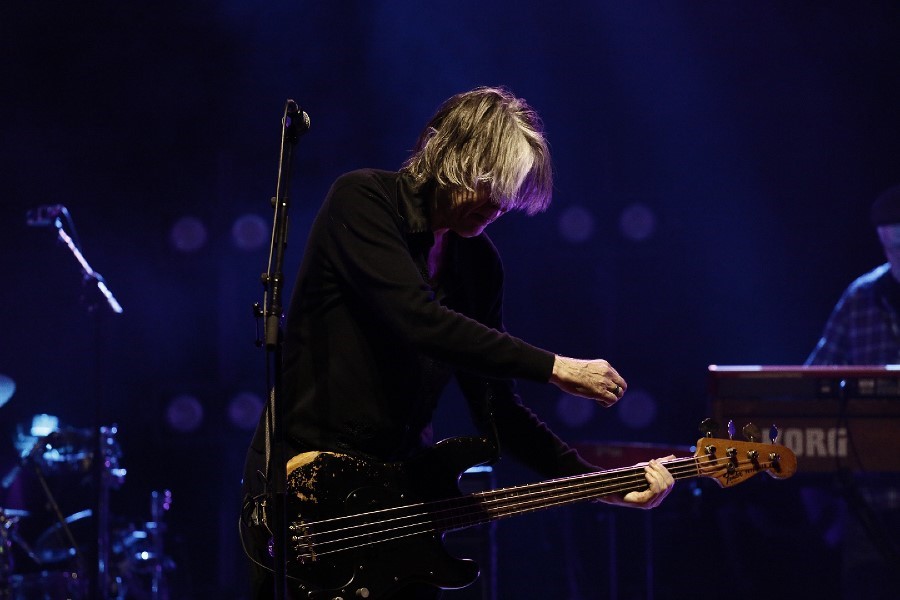
Del Amitri – Four Decades of Beautiful Disillusionment
Few bands have made romantic disappointment, personal inadequacy and the general absurdity of human existence sound quite as appealing as Del Amitri. Justin Currie has spent much of his career writing songs that would be thoroughly depressing were it not for his seemingly inexhaustible ability to find a magnificent melody to accompany them.
Wednesday evening at Nottingham’s Royal Concert Hall, as part of the band’s Past to Present tour, offered a celebration of precisely that talent.
 Opening proceedings were Glasgow five-piece Former Champ, an inspired choice of support whose enthusiasm for beautifully constructed guitar music made them particularly well suited to the occasion. There is something wonderfully infectious about their brand of power pop, with shades of Teenage Fanclub, the Big Star school of songwriting and the occasional flourish of classic rock guitar.
Fronted by Claire McKay, the band have a knack for combining bright, jangling melodies with a pleasingly muscular guitar sound. Their debut album, I Saw You in Paradise, is well worth investigating, particularly for anyone who believes that the world would be a slightly better place if more bands concerned themselves with writing genuinely memorable choruses. Former Champ deserve an audience of their own, and considerably more than half an hour in which to win one over.

Del Amitri have always occupied a curious position within British popular music. Too literate to be dismissed as mainstream radio rock, too commercially successful to retain any meaningful indie obscurity and sufficiently uninterested in fashion to outlast almost every musical movement with which they have shared the charts.
Not Where It’s At is a particularly appropriate opening statement for a band whose career has frequently existed outside the prevailing musical trends. The irresistible swagger of Kiss This Thing Goodbye, the wonderfully skewed observations of Just Like a Man and the expansive melodies of Here and Now demonstrate just how much musical variety exists within a catalogue that is sometimes rather lazily reduced to a handful of radio favourites.
 Iain Harvie’s contribution to that sound deserves considerable recognition. His guitar work provides both the bite and the beauty in Currie’s compositions, while the collective musicianship of the band allows the songs room to breathe. There is a warmth to the instrumentation that owes as much to classic American roots music as it does to British alternative rock.
Of course, Currie remains a songwriter of quite exceptional emotional intelligence. Driving With the Brakes On captures the complicated silences of a relationship with devastating economy, while Tell Her This manages to be achingly romantic without succumbing to sentimentality. Move Away Jimmy Blue remains a remarkable piece of storytelling, populated by the sort of characters whose entire lives seem to exist somewhere beyond the confines of its verses.
There is also something particularly satisfying about the inclusion of material from Fatal Mistakes. The excellent Missing Person and All Hail Blind Love sit comfortably alongside songs written decades earlier, testament to the quality of a comeback album that deserved far greater attention than it received.
And for all the intelligent melancholy associated with Del Amitri, they are frequently tremendous fun. Always the Last to Know must rank among the finest examples of someone turning romantic humiliation into an absolutely glorious pop song, while the gloriously ragged Stone Cold Sober reminds us that this is a band perfectly capable of making a thoroughly enjoyable racket.
Be My Downfall, meanwhile, belongs in that peculiar category of songs that become more emotionally complicated the older you get. Currie writes about the things people rarely admit to themselves, never mind to one another, and there is an uncomfortable recognition in some of his finest work.
 Then there is Nothing Ever Happens. Written towards the end of the 1980s, its observations about consumerism, social indifference and the repetitive nature of modern existence have aged almost alarmingly well. One suspects Currie would have been quite happy for the song to have become considerably less relevant by now.
Four decades into their career, Del Amitri remain one of Britain’s most rewarding guitar bands. There is no shortage of acts touring their greatest hits these days, but relatively few possess a collection of songs quite this rich in character, wit and emotional substance.
A thoroughly splendid evening in the company of a band who have spent forty years making life’s disappointments sound wonderful.