There is something rather reassuring about living in a world where Brian Bilston can fill theatres with people who have willingly paid to listen to poetry. In an age of diminishing attention spans, relentless digital distractions and increasingly shouty public discourse, the popularity of a softly spoken man with an extraordinary talent for rearranging words feels like a small but significant victory for civilisation.
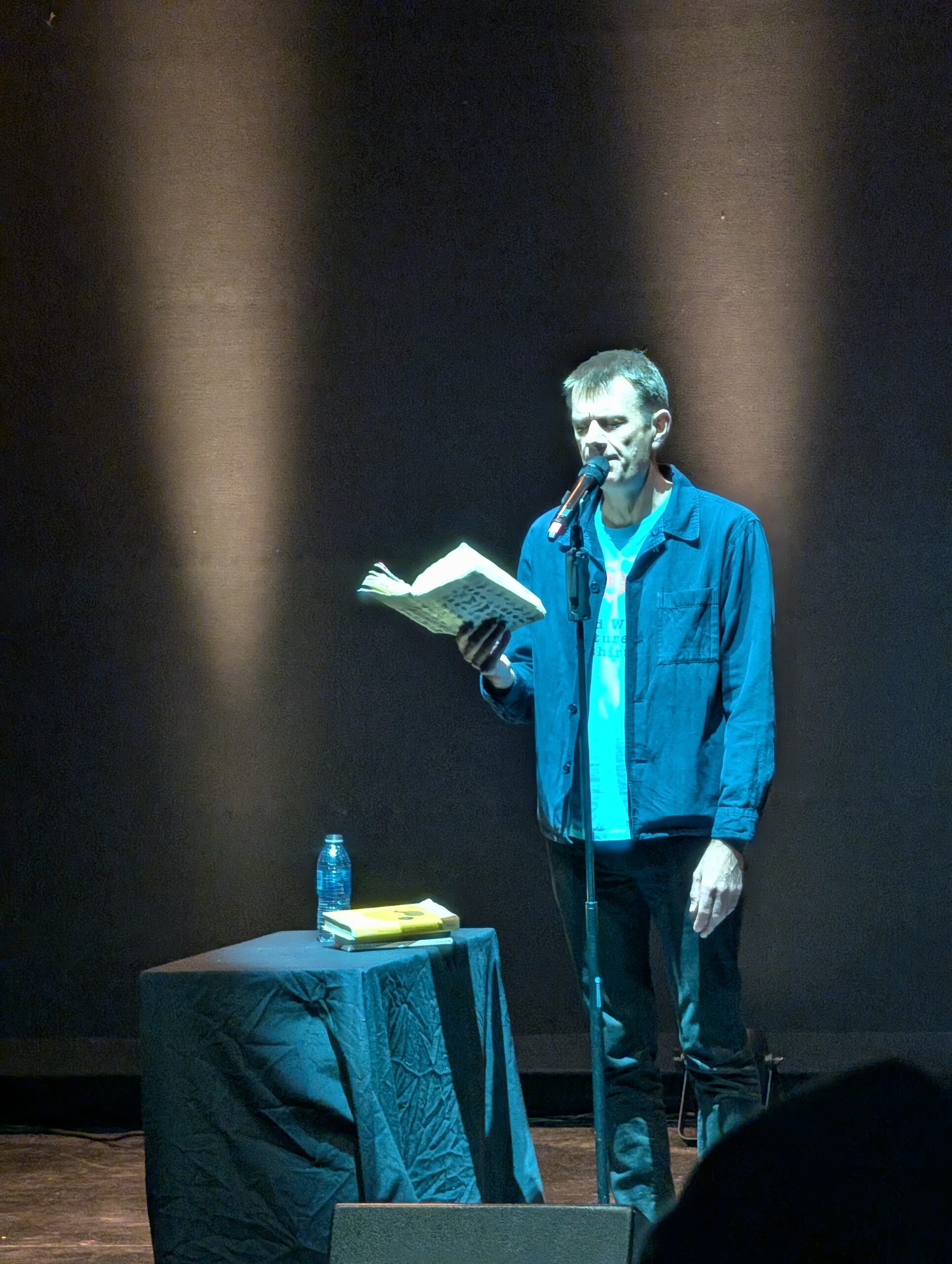
Bilston’s appearance at Newark’s Palace Theatre on Wednesday evening, as part of his How to Lay an Egg with a Horse Inside tour, was a delightful celebration of language, imagination and the frequently absurd business of being human.
For those whose relationship with poetry ended somewhere between being forced to analyse a metaphor at school and wondering why the curtains being blue apparently represented existential despair, Bilston offers a wonderfully refreshing alternative.
There is no intellectual gatekeeping here, no suggestion that poetry belongs exclusively to those armed with an English literature degree and a sufficiently troubled relationship with their parents. Bilston finds inspiration in the everyday, often in things that the rest of us would scarcely consider worthy of a second thought.
One of the evening’s highlights was a poem that Bilston jokingly suggested he hoped would establish him on the funeral circuit. Whilst thoroughly hilarious, it also shone a light on the growing homogenisation of society. In a world that increasingly encourages us to buy the same things, aspire to the same lifestyles and measure success against the same criteria, there is something faintly tragic about the erosion of individuality. I found myself returning to the sentiment behind the poem long after the laughter had subsided.
The sheer breadth of the evening’s material was particularly impressive. A found poem exploring the very nature of poetry occupied a wonderfully surreal territory somewhere between nonsense and philosophy, punctuated by moments of genuinely profound insight. The apparent incongruity of some of its constituent parts made those moments all the more striking.
And then, of course, there was the poem written by a cat. Quite how we had arrived at feline literature after contemplating the philosophical nature of poetry scarcely mattered. It was gloriously ridiculous.
Bilston’s exploration of artificial intelligence was equally entertaining, featuring both poems written by AI and poems written about it. Beyond the obvious comic potential, there were some interesting questions about creativity and authorship. At a time when technology is becoming increasingly adept at reproducing the mechanics of writing, Bilston’s wonderfully individual perspective seemed particularly valuable.
There is, after all, a considerable difference between knowing how words fit together and having something worth saying.
Much of the charm of seeing Bilston live comes from his understated delivery. He has an endearingly unassuming stage presence and a knack for knowing precisely how long to leave a pause. Given how much of his humour depends upon an unexpected final line or a sudden change of meaning, his timing is particularly important. Even when you suspect that a linguistic ambush is imminent, he frequently manages to catch you out.
There are elements of Spike Milligan’s linguistic anarchy, Victoria Wood’s affectionate observations of everyday life and Douglas Adams’ delight in the absurd. Bilston, though, has a voice quite distinct from any of them. He seems permanently intrigued by the peculiarities of the English language and the increasingly peculiar ways in which we choose to live our lives.
Calling him a comic poet, whilst entirely understandable, feels somewhat inadequate. Some of his funniest observations are also amongst his most perceptive, and there were several occasions during the evening when the implications of a poem only really struck me once I had finished laughing.
Perhaps what I like most about Bilston is that his considerable cleverness never comes at the expense of his audience. There is no smugness to his wit. He invites us to share in his amusement at the world, and occasionally at ourselves.
In many respects, Bilston has accomplished for poetry what some of our finest folk musicians have achieved with traditional song. He has made an art form that many people consider intimidating feel welcoming and relevant without compromising its intelligence or complexity.
Much of his popularity has been built through social media, where his poems offer little moments of pleasure amid the endless procession of advertisements, arguments and photographs of other people’s lunches. There is something rather special, however, about experiencing those poems collectively. The intimacy of the Palace Theatre suited Bilston beautifully.
There is also a great deal of warmth to his writing. Even his more pointed observations tend to be directed at the absurdities of human behaviour rather than the vulnerabilities of individuals. It is refreshing to spend an evening laughing so much without feeling that somebody else has had to suffer for the privilege.
Any performance that can encompass mortality, social conformity, artificial intelligence, the philosophical nature of poetry and the literary ambitions of a domestic cat deserves considerable credit. The content was as broad as it was funny, and as funny as it was thought-provoking.
I suspect that many of us left the Palace Theatre with a renewed appreciation of the possibilities of language and perhaps even a little enthusiasm for attempting some poetry ourselves.
Whether any of us can compete with the cat is another matter entirely.
A thoroughly lovely evening.