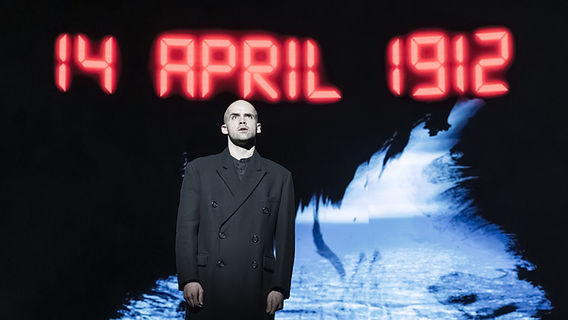
 The recent run of Hamlet at Theatre Royal Nottingham offered a striking reinterpretation, setting the action aboard an ocean liner unmistakably inspired by the Titanic. That choice gave the production an immediate sense of inevitability, framing the story within a world that appears grand and controlled, yet is quietly heading toward disaster.
From the outset, the setting proved more than a visual hook. The ship, rooted in a 1912 aesthetic, carried clear echoes of the Titanic without needing to state it outright. The polished surfaces, structured hierarchy, and sense of order created a world that felt stable on the surface but deeply fragile underneath. It was a fitting parallel to Elsinore itself: a court built on appearances, already beginning to fracture.
The staging made excellent use of levels, ropes, and confined spaces. Characters were often positioned above or below one another, reinforcing shifting power dynamics, while the constant sense of enclosure heightened the tension. There was no escape, either politically or physically, and that claustrophobia fed directly into the emotional core of the play.
At the centre, Hamlet’s performance anchored everything. There was a convincing blend of sharp intellect and emotional volatility, with the soliloquies delivered in a way that felt immediate and unguarded. “To be or not to be” became less a philosophical exercise and more a moment of private crisis, intensified by the knowledge that the world around him, like the ship itself, is on an inevitable course toward collapse.
Claudius carried a controlled authority, but it was Polonius who provided much of the comic relief. His presence brought well-judged moments of levity that never undermined the tension, instead sharpening it by contrast. The humour felt rooted in character, offering brief release before the production pulled the audience back into darker territory.
Gertrude was played with a careful ambiguity, while Ophelia’s descent was particularly affecting. The instability of the setting amplified her unravelling, giving her later scenes a disorientating, almost dreamlike quality that lingered long after.
Pacing was confident throughout. The ship setting allowed for fluid transitions, with different areas of the deck transforming seamlessly into new locations. This kept the narrative moving with purpose, maintaining a strong sense of momentum while still allowing key moments to breathe.
By the final act, the Titanic-inspired framing came fully into focus. The sense of inevitability was no longer subtle; it was overwhelming. Like the ship itself, the world of the play felt destined to break apart, and when the tragedy finally unfolded, it did so with a quiet, devastating certainty rather than spectacle.
Overall, this Nottingham production of Hamlet was both inventive and emotionally grounded. The Titanic influence added a powerful layer of meaning, reinforcing the play’s themes of fragility, power, and inevitable consequence. Combined with strong performances and carefully balanced moments of humour through Polonius, it resulted in a production that felt both fresh and deeply respectful of the original.