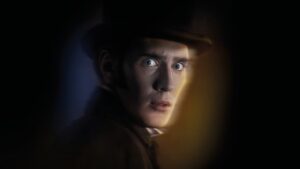
There are ghost stories, and then there are ghost stories that quietly crawl under your skin. The Woman in Black, currently haunting the stage at Nottingham’s Theatre Royal, firmly belongs in the latter category. It is a piece of theatre that reminds us you do not need elaborate sets or cinematic effects to unsettle an audience. Atmosphere, imagination and two performers capable of holding a room in complete silence are more than enough.
Adapted by Stephen Mallatratt from Susan Hill’s novel, the play follows Arthur Kipps, a solicitor tormented by a terrifying experience from his past. Years later he attempts to exorcise the memory by hiring an actor to help him stage the events that still haunt him. What begins as a simple rehearsal gradually transforms into a chilling recreation of Kipps’ journey to the remote Eel Marsh House and his first encounter with the mysterious figure known only as the Woman in Black.
What makes the production so effective is its restraint. The staging is deliberately minimal: a handful of props, carefully controlled lighting and an inventive use of sound to create whole landscapes. Instead of showing everything, the play invites the audience to imagine it. That invitation is exactly where the fear takes hold. The theatre becomes part Victorian storytelling chamber, part haunted landscape, and when the inevitable shocks arrive they land with impeccable timing.
Those shocks clearly hit their mark. Throughout the evening, genuine screams could be heard from different parts of the audience, followed by bursts of relieved laughter once the moment had passed. It is always a good sign when a theatre crowd becomes part of the experience, and this Nottingham audience was completely drawn into the story’s rising tension.
At the centre of the production are just two performers. With so little on stage, the entire show rests on their ability to sustain tension and carry the narrative. Fortunately, the pairing works beautifully. One brings the haunted weight of Kipps’ memories, while the other injects energy and theatrical flourish as the actor helping him tell the story. The two move fluidly between narration and character, humour and dread, allowing the audience to become fully immersed in the unfolding tale.
What is particularly striking is the patience of the production. The tension builds slowly and deliberately. Early scenes feel almost playful as the mechanics of storytelling are introduced, but gradually the tone darkens and the atmosphere thickens. By the time the truly unsettling moments arrive, the entire theatre seems to lean forward at once, caught in that rare collective silence that only live theatre can produce.
The stripped back staging occasionally asks the audience to do a little imaginative work, but that is part of the production’s enduring charm. Rather than relying on spectacle, The Woman in Black depends on classic theatrical craft: careful pacing, shadow, suggestion and the perfectly timed shock.
More than thirty years after it first appeared on stage, the play still demonstrates why it became one of the longest running productions in West End history. The Nottingham audience was clearly captivated, responding audibly to every flicker of tension and every sudden jolt of fear.
In the end, The Woman in Black is a reminder that theatre can be most powerful when it trusts the audience. With little more than two actors, a darkened stage and a well told story, it conjures an atmosphere that lingers long after the curtain falls. You may leave the Theatre Royal smiling at the cleverness of it all, but there is every chance you will glance over your shoulder on the walk home.