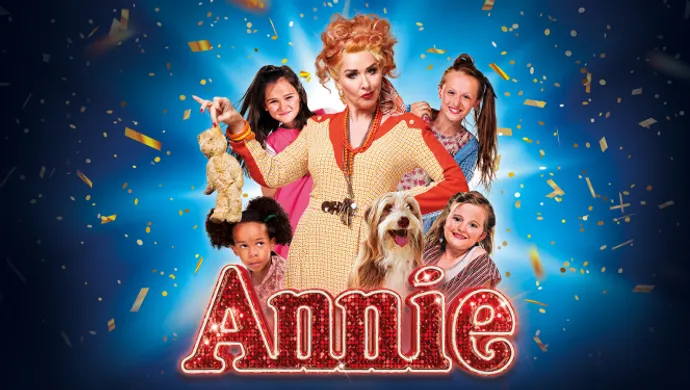
There are some musicals that seem almost indestructible. Annie is one of them. Nearly half a century after it first reached Broadway, its combination of optimism, sentiment and instantly recognisable songs continues to bring audiences through theatre doors, and its latest visit to Nottingham demonstrates just how firmly the show has become part of the musical theatre landscape.
Set against the bleak backdrop of Depression-era New York, Annie has always found its warmth in contrast. Its young heroine begins the story in an orphanage overseen by the formidable Miss Hannigan, still convinced that somewhere beyond its walls her parents are waiting for her. A chance encounter eventually takes her into the extraordinary world of billionaire Oliver Warbucks, and from there the musical develops into its familiar mixture of fairy tale, comedy and social commentary.
It is easy to forget quite how dark the world surrounding Annie actually is. Poverty, homelessness and desperation sit alongside the brighter Broadway spectacle, while Warbucks’ enormous wealth provides an intentionally stark contrast. At its centre, however, is a remarkably simple idea: that circumstances need not determine what comes next.
That message is perhaps the reason Annie has endured so well. Annie herself is not simply waiting to be rescued. Her defining characteristic is an almost stubborn refusal to surrender to cynicism, even when virtually every adult around her has considerably more reason to be cynical.
And then, of course, there are the songs. Few family musicals can call upon a collection quite as deeply embedded in popular culture. Maybe, It’s the Hard Knock Life, Easy Street and I Don’t Need Anything But You all lead towards the inevitable Tomorrow, a song so familiar that the opening notes alone are enough to provoke recognition.
The Nottingham audience responded warmly to that familiarity, particularly to the show’s broader comic moments and its big ensemble numbers. There is something undeniably communal about watching a musical whose major beats are already known by much of the room: children discovering the story for the first time sit alongside adults who may have known these songs for decades.
Perhaps that is ultimately the great strength of Annie. Productions change and generations of performers come and go, but its central appeal remains remarkably intact. It is an unapologetically hopeful musical about finding family, refusing despair and believing that tomorrow might genuinely be better than today.
At a time when optimism can sometimes feel in short supply, there are considerably worse messages for a theatre to send its audience home with.